ArticlesPoliticsReportsU.S.AWorld

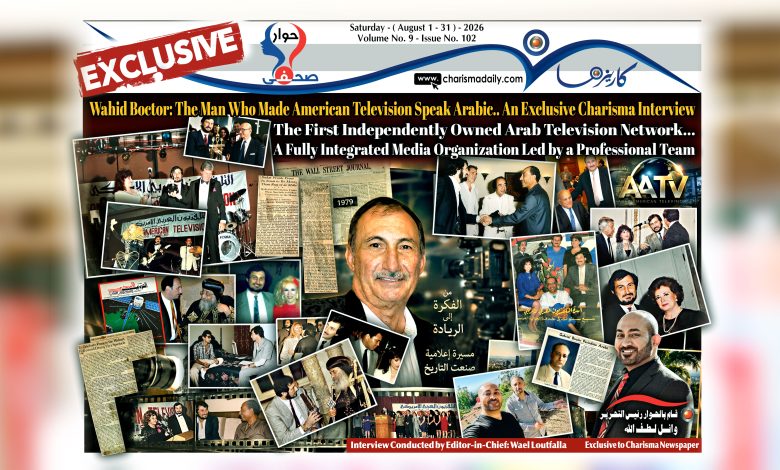
Wahid Boctor: The Man Who Made American Television Speak Arabic.. An Exclusive Charisma Interview

Interview Conducted by Editor-in-Chief: Wael Loutfalla

The First Independently Owned Arab Television Network…
A Fully Integrated Media Organization Led by a Professional Team.

From Chance to Leadership: The Complete Story of AATV, America’s First Arab American Television Network.

A Rare Wall Street Journal Archive Document: Wahid Boctor Led the Largest Historic Peace Celebration Honoring President Anwar Sadat Alongside World Leaders.

The 25-Year Story of Arab American Television: A Landmark Brand That Earned Global Recognition.

The Man Ahead of His Time: The Visionary Behind America’s First Arab American Television Network.

We Broadcast the Truth and Paid the Price: Inside the Most Dangerous Battles of Arab American Television.

Algorithms Are the New Censors: How Artificial Intelligence Is Reshaping the Future of Media.

The Complete Story of AATV: America’s First Arab American Television Network.
At a time when there were no digital platforms, no social media, and no internet streaming, one man believed that media was far more than a television screen it was a powerful message capable of bringing people together before politics, religion, or geography could divide them. From the heart of California emerged one of the boldest and most influential Arab media ventures in the United States, led by pioneering broadcaster Wahid Boctor, who founded the first Arab American Television (AATV) in 1980, laying the cornerstone for an independent Arab media platform dedicated to serving immigrant communities while preserving their cultural identity and human values.

Yet Wahid Boctor’s story did not begin inside a television studio. It began in an extraordinary home where journalism met the arts, and where Muslims, Christians, and Jews lived side by side an environment that reflected the spirit of Egypt’s rich tradition of coexistence and mutual respect. Raised in a multicultural and multi faith family, he grew up embracing the values of dialogue, understanding, and inclusion. His father, one of Egypt’s most distinguished journalists and writers, inspired him from an early age, allowing him to breathe journalism from childhood and to believe that the written and spoken word should build bridges between people rather than deepen divisions.

His academic journey was equally remarkable. Boctor studied Architecture at the Faculty of Fine Arts, Alexandria University, before expanding his expertise through specialized studies in France. He later moved to the United States, where he earned a Master’s degree in Communication Production from Loyola Marymount University. Fluent in five languages, he developed the rare ability to communicate across cultures, shaping a media philosophy that was far ahead of its time one that combined artistic creativity, academic excellence, and a genuinely global perspective.

For more than twenty five years, Arab American Television (AATV) was far more than a television channel. It became a historic platform that documented the story of Arab communities across the United States, welcomed presidents, world leaders, artists, intellectuals, political figures, and some of the most influential members of the Arab American community, while presenting a truly independent media model at a time when resources were limited but ambition knew no boundaries.

In this exclusive interview with Charisma Newspaper, Wahid Boctor opens the pages of his extraordinary journey for the very first time. He reflects on the formative experiences that shaped his vision, reveals the untold story behind the creation of America’s first Arab American Television network (AATV), recounts the triumphs and challenges that defined its remarkable legacy, shares memorable encounters with presidents, kings, and internationally renowned artists, offers his perspective on journalism in the age of artificial intelligence, and delivers an inspiring message to the next generation of media professionals.

This is more than an interview it is a living testimony to a defining chapter in the history of Arab media in the diaspora and the story of a visionary whose ideas were years ahead of their time. His pioneering legacy remains as relevant today as ever, deserving to be preserved and passed on to future generations.


Tell us about your journey from your early years in Egypt and Alexandria, to France, and eventually the United States. How did these different chapters of your life, combined with your fluency in five languages, shape your personality and influence your career in the media industry?

I was born in Alexandria, Egypt a city that remains deeply woven into my identity and spirit. To me, Alexandria has never been just a place on the map; it has always been a living symbol of coexistence, cultural diversity, and intellectual openness. Throughout its rich history, the city embraced Greek, Armenian, French, Italian, and many other communities, creating an extraordinary cosmopolitan society unlike almost any other in the world. Its timeless charm and unique character continue to make it one of the world’s truly exceptional cities.

For me, Alexandria was far more than the place where I grew up it was the first school that shaped my personality, nurtured my curiosity, and instilled in me a lifelong appreciation for knowledge and cultural exchange. I also have a younger brother, Wagih, and growing up between Alexandria and Cairo** gave me the privilege of experiencing two remarkably different worlds: one steeped in history and multicultural heritage, and the other serving as the vibrant heart of Egypt’s media, arts, and cultural life.

From an early age, I believed that success is never built on talent alone. It requires continuous learning, discipline, and an unwavering commitment to personal growth. That belief led me to study Architecture at the Faculty of Fine Arts, Alexandria University a field that uniquely combines engineering precision with artistic imagination and creative vision. My architectural education gave me much more than a university degree; it taught me how to think systematically, transform ideas into tangible realities, and strike the perfect balance between aesthetics and functionality principles that would later become fundamental to my career in media.

Yet I have always believed that education has no borders. After graduation, I traveled to France to pursue advanced professional training, where I was introduced to new perspectives in culture, management, the arts, and critical thinking. That experience became a defining turning point in my life. It taught me that cultural differences are never barriers they are opportunities to broaden one’s perspective, embrace new ideas, and see the world through a richer and more inclusive lens.

The most transformative chapter of my journey began when I moved to the United States, where I earned my Master’s degree in Communication Production from Loyola Marymount University . In that highly advanced academic environment, I gained far more than technical expertise in media production and communications. I developed a deeper understanding of how world-class media organizations operate and how responsible journalism can build bridges between cultures, influence societies, and help shape public opinion.

Another defining factor in my professional journey has been my fluency in five languages: Arabic, English, French, Italian, and Spanish. For me, languages have never been merely tools of communication; they have been gateways to understanding different cultures, appreciating diverse perspectives, and building meaningful professional and personal relationships with individuals and institutions across the globe.

Looking back today, I see that every chapter of my life naturally prepared me for the next. Alexandria gave me my roots; architecture taught me discipline, structure, and creativity; France broadened my intellectual horizons; the United States refined my media expertise; and mastering five languages opened the doors to the world.

That is why I firmly believe that genuine success is never the result of a single achievement. Rather, it is the culmination of diverse experiences, cultural enrichment, and an enduring commitment to lifelong learning. It was this unique combination of experiences that ultimately enabled me to pioneer the launch of California’s first Arab-American television station, AATV, connect with communities from many cultural backgrounds, and build a media career with a truly global perspective while remaining deeply proud of my Egyptian identity and heritage.


You grew up in a family where art, journalism, and a rich blend of religions and cultures came together. How did this unique environment shape your personality?

I can confidently say that my character was shaped far more at home than in any school or university. I was raised in an extraordinary environment where journalism met the arts, and where religious and cultural diversity was simply a way of life. That unique upbringing gave me, from an early age, a broader perspective on people, society, and the world around me.

In Cairo, my father, Gabriel Boctor , was one of Egypt’s distinguished journalists and writers. He served as a journalist and art critic for Dar Al-Hilal, worked for the French language newspaper Le Journal d’Égypte, and authored several notable books. Among them were studies on the celebrated painter Mahmoud Saeed, a collaborative book with Badr El-Din Abu Ghazi on the renowned sculptor Mahmoud Mokhtar, a historical work exploring the remarkable parallels between Mexico and Egypt from ancient civilizations to modern times, and From the Nile to the Mekong, a book chronicling Cambodia. A gifted multilingual journalist, he worked fluently in Spanish, French, Portuguese, and Arabic, contributing to some of Egypt’s most prestigious publications, including Dar Al-Hilal, Al-Mosawer*, Al-Kawakeb,  Hawaa,  Samir, Mickey, Superman, and the magazine Image .

For me, journalism was never merely a profession it was part of everyday life. I watched stories take shape, experienced the atmosphere of editorial rooms, and had the privilege of meeting many of Egypt’s leading writers, artists, and intellectuals. Among them were renowned painter Salah Taher, sculptor Mahmoud Mokhtar, and many other iconic figures who helped shape Egypt’s cultural landscape. Those experiences planted within me an enduring passion for knowledge and sparked my lifelong love for media and the arts.

Alexandria, on the other hand, gave me an equally valuable human dimension. There, I grew up in a family that embodied the true meaning of coexistence. I had three aunts, each living a different life: one was married to a Muslim, another to a Coptic Orthodox Christian, and the third to a Jewish husband. Despite their different faiths, I never witnessed a single disagreement rooted in religion. Love, mutual respect, and family bonds always outweighed any differences in belief. We celebrated each other’s occasions as one family, teaching me from childhood that a person is defined not by religion, but by character, integrity, and values.

One historical figure who also left a lasting imprint on our family legacy was Chief Rabbi Haim Nahum Effendi of Egypt, the uncle of one of my aunt’s husbands. He was widely respected for his unwavering commitment to dialogue, coexistence, and mutual understanding. He believed that people of different backgrounds could live together peacefully within the same homeland, and that conflict could never build a better future.

Looking back on my media career today, I realize its foundations were laid in that remarkable environment. It taught me that diversity is not a source of division but a source of strength and enrichment, and that authentic journalism should serve as a bridge connecting people rather than a tool that widens their differences. I have carried that conviction with me throughout every stage of my professional journey, firmly believing that people deserve respect because of their humanity and moral character, and that dialogue, tolerance, and peaceful coexistence remain the cornerstones of every strong and enduring society.


How did the character of Haim Nahum Effendi your great aunt’s husband’s uncle reflect the nature of Egyptian society, where Jews, Christians, and Muslims lived together under the umbrella of a shared national identity?

When I reflect on the Egypt in which I was raised, I often think of the remarkable life of Chief Rabbi Haim Nahum Effendi, my great-aunt’s husband’s uncle. His story remains one of the clearest reflections of the spirit of that era. Egypt was then a unique model of coexistence, where religion was never a barrier to knowledge, culture, or public service. What truly mattered was one’s intellect, integrity, and contribution to the nation.

Haim Nahum Effendi was far more than the Chief Rabbi of Egypt’s Jewish community. He was one of the foremost scholars of his generation, renowned for his extraordinary command of languages, law, history, and Oriental studies. His academic distinction and intellectual stature earned him the admiration of both the Egyptian state and society. Appointed Chief Rabbi in the 1920s, he was later selected to serve as a member of the Egyptian Senate and became one of the founding members of the Arabic Language Academy in Cairo an extraordinary recognition that reflected Egypt’s commitment to honoring scholarship and merit above religious affiliation.

That image carried a profound message. The presence of a Jewish religious leader in both the Egyptian Senate and the Arabic Language Academy was not viewed as unusual in Egypt at the time; rather, it was a natural expression of a society that believed national identity embraced all its citizens. Muslims, Christians, and Jews were partners in building the nation and enriching its cultural heritage. It was in this spirit that Haim Nahum served alongside such towering intellectuals as **Taha Hussein** at the Arabic Language Academy.

His contributions extended well beyond religious leadership and public service. Among his most enduring scholarly achievements was the compilation and translation of the Ottoman firmans imperial decrees issued to the governors of Egypt from the Ottoman conquest in 1517 through the late nineteenth century. This monumental work remains an indispensable reference for historians of both Egypt and the Ottoman Empire.

Haim Nahum was also offered the presidency of Israel, an offer he categorically declined because of his opposition to Zionist policies and the seizure of Palestinian lands.

He remained in Egypt until his passing in 1960 and was laid to rest in the historic Jewish cemetery of Basatin in Cairo. His life embodied a remarkable chapter in Egypt’s history one in which the nation embraced all of its sons and daughters, regardless of faith, within a framework of mutual respect, shared citizenship, and national belonging. Those enduring values left a profound imprint on my own character and continue to shape the way I view humanity, coexistence, and Homeland.


Every great beginning has an extraordinary story. How was the idea of launching Arab television born more than three decades ago?

Was it a dream and a carefully crafted vision from the very beginning, or did chance ultimately lead you to this groundbreaking media venture?

If you want the honest truth, the answer is simple: it happened by chance. Launching an Arabic television network was never part of my plans. I never sat down with a blueprint to build a media organization of that scale. Sometimes, life chooses your path before you choose it yourself—and that’s exactly what happened to me.

I was raised in an extraordinary family in every sense of the word, one that brought together members of the Jewish, Christian, and Muslim faiths. From an early age, I experienced a rare model of human coexistence, where differences were never a source of division but rather a source of richness, understanding, and mutual respect. We celebrated one another’s religious holidays, visited each other, and shared genuine affection and appreciation. Never once did I feel that religious identity could become a barrier between members of the same family.

That upbringing shaped my philosophy of life long before it shaped my philosophy of journalism. It taught me that people matter more than labels, that dialogue is stronger than conflict, and that knowledge has the power to dismantle the walls built by prejudice.

When I later moved to the United States, I was surprised to find Arab communities living in isolated pockets, while the Arab voice in the American media landscape was virtually nonexistent. At that moment, what had begun as a coincidence evolved into a mission. I realized there was a genuine need for a media platform that would unite rather than divide, present an authentic image of Arabs to American society, and at the same time help preserve the cultural identity of Arab American communities.

That is how Arab American Television was born. It was never conceived as a commercial venture, but as a humanitarian and cultural mission dedicated to building bridges of dialogue and mutual understanding between peoples and cultures. I have always believed that chance may open the door, but it is conviction, unwavering commitment, and perseverance that transform an unexpected opportunity into a pioneering institution capable of enduring for decades.


How did the journey of founding Arab American Television begin? What were the very first steps that led to its launch, and what resources did you have at your disposal?

 Sometimes the greatest ventures begin with a simple question, a passing observation, or even a chance encounter that changes the course of a life. That is exactly how the idea of founding Arab American Television (AATV) came to be. It was never a project I had carefully planned from the outset. Rather, it emerged from a deeply personal and professional journey that gradually shaped a different vision of what media could accomplish.

I had studied Film Production and gained hands on experience working on independent American film projects. Like many young people entering the industry, I dreamed of making it in Hollywood. But I soon discovered the reality: breaking into one of the world’s most competitive entertainment industries was extraordinarily difficult especially as an Arab immigrant navigating fierce competition and significant professional barriers.

At the same time, I was closely observing the Arab community in the United States. I noticed that every community tended to remain within its own circle, with each group largely isolated from the others. Religious and cultural differences often created barriers instead of building bridges. That realization led me to ask myself one simple question one that would ultimately change the course of my life:

Why wasn’t there a media platform that united Arabs instead of dividing them?

That question marked the beginning of the journey.

From the very beginning, my vision went far beyond creating another television program or launching a new channel. I wanted to build a media home where every Arabic speaker could feel a sense of belonging regardless of nationality, religion, or cultural background. I firmly believed that our shared language, culture, and heritage possess a unique power to bring people together, transcending political and religious divisions.

Choosing the name Arab American Television (AATV) was, at the time, a bold decision. The name itself was more than a brand it was a statement of purpose. I wanted it to serve as an umbrella that embraced everyone, not a platform representing one community at the expense of another. It reflected my conviction that a shared cultural identity could be stronger than the forces that divide us.

From day one, we embraced arts and culture as our universal language. The music of Umm Kulthum, Abdel Halim Hafez, Fairuz, and other legendary Arab artists represented a collective memory shared by people across the Arab world, regardless of nationality or faith. That is why our concerts, television programs, and cultural events attracted audiences from every corner of the Arab community including Jews of Arab heritage who joined together in celebrating their common love for Arabic language, culture, music, and tradition.

It was in those moments that I realized a fundamental truth: meaningful media is not built upon differences, but upon what people share. Culture and the arts can often achieve what politics cannot, especially when the message speaks first to our common humanity before it speaks to any other identity.


Choosing the name Arab American Television (AATV) was a bold move at the time. Weren’t you concerned it might spark controversy or face resistance from the diverse Arab communities with their different identities and backgrounds?

I never hesitated for a moment in choosing the name Arab American Television (AATV) . To me, it was the name that had the greatest power to unite people rather than divide them. From the very beginning, I asked myself one simple question: What could bring together an Iraqi, a Lebanese, a Syrian, an Egyptian, a Moroccan, an Arab Jew, a Christian, a Muslim, and every member of the Arab diaspora? The answer was clear:  the Arabic language . It is the common thread that transcends religion, ethnicity, and nationality, carrying within it a shared history, culture, and identity.

That is why the word “Arab” was never a gamble in my eyes. It was a statement of inclusion a declaration that this platform belonged to everyone. Its mission was never to represent a particular political, religious, or ideological group, but rather to serve everyone connected to Arab culture and the Arabic language, regardless of faith or cultural background.

I was equally convinced that art is the language that unites Arabs more than anything else . The timeless legacy of legendary performers such as Umm Kulthum, Abdel Halim Hafez, Fairuz, Farid Al-Atrash, Sabah Fakhri, Ismail Yassin, and countless other icons of Arab culture lived in the hearts of all Arabs including Jewish communities of Iraqi, Syrian, and Egyptian heritage, many of whom maintained a profound emotional connection to this rich artistic and cultural legacy.

We witnessed this reality firsthand. Whenever AATV organized concerts featuring celebrated artists such as the legendary Sabah Fakhri the venues were filled with members of Arab communities from every background. Muslims, Christians, and Jews of Arab origin gathered under one roof, sharing the same music, the same memories, and the same cultural experience. Religious beliefs and political differences simply faded into the background. Those moments reaffirmed my conviction that  shared language, culture, and the arts are far more powerful than the forces that divide us .

That experience confirmed that choosing the name Arab American Television (AATV) was the right decision. It proved that media can serve as a bridge for dialogue, understanding, and human connection not a tool for deepening divisions.

With that vision, Arab American Television (AATV) officially launched in 1980, becoming the first media platform dedicated to serving the Arab American community in all its diversity. For more than twenty five years, it pioneered a model of inclusive journalism that was well ahead of its time, bringing together Arab communities under one umbrella while preserving their shared cultural identity.

At the time, AATV represented a groundbreaking media experiment. It was the first independently owned Arab television outlet in the United States, at a time when most Arab media organizations particularly television networks were either state owned or operated under direct government influence. That independence gave the channel the freedom to present a distinctive editorial vision and a broader range of perspectives, offering programming that stood apart from the official narratives dominating the Arab media landscape of that era.


Did the name Arab American Television (AATV) influence how Arab governments perceived you, to the point where they sometimes treated you as though you represented an official American institution? And how did that perception shape your meetings with Arab presidents and leaders?

 At the beginning of my journey, simply using the word “Arab”  brought me more challenges than I had ever anticipated. I quickly discovered that identity was a far more sensitive and complex issue than I had imagined. Some Lebanese Christians identified themselves as Phoenicians rather than Arabs, while many Copts and Egyptians insisted that they were Egyptian first and rejected being described as Arabs.

The issue extended well beyond Lebanon and Egypt. I met Tunisians and Moroccans who proudly identified as Amazigh (Berber) and believed that the label “Arab” did not reflect their heritage or identity. For some, it was a description they simply could not accept.

Perhaps the greatest surprise came from conversations with certain Saudis and other Muslims who argued that emphasizing the term “Arab” could weaken the broader concept of the Islamic Ummah, creating divisions where unity should prevail. It became clear to me that identity was never just a matter of terminology it was a deeply rooted and highly personal issue that varied from one society to another, with every community holding firmly to its own history, culture, and sense of belonging.

Over time, however, the name Arab American Television (AATV) evolved into far more than the title of a media outlet. It became a powerful identity that opened doors I never imagined could be reached. In the early years, I never expected that the name alone would give the organization such visibility and influence. But as AATV’s audience expanded and its reputation grew, I recognized the value of that identity and moved quickly to register it officially as a trademark rights that I continue to hold to this day.

During that period, many Arab governments came to view Arab American Television as a media institution with close ties to, or some form of affiliation with, the United States. Whether accurate or not, that perception gave the network a unique level of credibility and opened doors to senior officials and decision-makers across the Arab world. As a result, I began receiving official invitations from several Arab countries to conduct exclusive interviews with presidents, kings, and high-ranking government leaders.

We were invited to major regional media conferences attended by Ministers of Information from Iraq, Kuwait, Libya, and Egypt, providing unprecedented access to the highest levels of political leadership. Among the most notable invitations was my visit to Iraq to interview President Saddam Hussein, in addition to official visits to Kuwait to meet the Emir and other senior officials, as well as meetings with prominent political figures across several Arab nations. In many of these settings, the President of Arab American Television was regarded as the head of an internationally respected media organization an image that granted me rare access to decision-making circles and opportunities for interviews that were extraordinarily difficult to secure at the time.

I never sought to capitalize on that perception for personal gain. Instead, I saw it as an opportunity to advance my journalistic mission and expand meaningful dialogue between Arab leaders and the public. I firmly believed that when a strong name is backed by credibility, professionalism, and integrity, it can unlock even the most tightly closed doors and enable responsible journalism to reach influential voices and bring their perspectives directly to audiences.

As the years passed, these exclusive interviews became an integral part of  Arab American Television’s identity, reinforcing its standing as a respected media platform with influence across both the Arab world and the international stage. They demonstrated that journalism, when driven by a clear vision and a strong institutional identity, has the power to shape conversations and leave an impact that extends far beyond the television screen.


Your name appeared in a front page report published by The Wall Street Journal in 1979, identifying you as one of the key figures involved in organizing the historic Egypt Israel peace celebrations. The report also noted that, after months of effort, you succeeded in securing President Anwar Sadat’s approval for the project. How do you look back on that experience today? And what was the true nature of the role you played? 

That was one of the defining milestones of my professional career. It was far more than an artistic venture it was a cultural initiative with a message of peace, designed to speak to the world through the universal language of art at a time when the Middle East was experiencing one of the most pivotal moments in its modern history.

At the time, I was in Egypt working on a film project while simultaneously collaborating with a group of international producers to organize a major global celebration marking the new era of peace in the Middle East. Securing the necessary government approvals seemed almost impossible, but I believed deeply in the vision and remained determined to see it through.

Ironically, what everyone assumed would be the greatest obstacle turned out to be the easiest step. I did not have a prior appointment with the late President Anwar Sadat . Instead, I traveled to Al-Maamoura Palace in Alexandria, where he was spending his vacation. At the entrance, I was directed to meet Abdel Rahman Hafez, one of the President’s senior aides.

He asked me, “What brings you here?” I replied, “I have an idea about peace, and I would like to present it to the President.” When I explained that the proposal was to organize an international concert celebrating peace, he smiled skeptically and said, “Do you really think the President has nothing more important to do than meet someone who wants to organize a concert?” He added that he would try to direct me to the appropriate government office, insisting that the President would never set aside time for such a request.

About thirty minutes later, he returned looking both surprised and bewildered. I asked, “What happened?” With a smile that still reflected his disbelief, he simply said, “Please come in… The President wants to meet you.”

That meeting transformed the entire project. I presented President Sadat with my vision of turning the celebration into a global cultural statement one that would demonstrate how art can strengthen peace and bring nations closer together. Following a series of official procedures and approvals, the project received full government endorsement, and a decision was made to build an open air amphitheater on Mount Sinai to host this historic international event.

This achievement was not merely preserved through personal recollection it was documented by The Wall Street Journal in its September 27, 1979 edition. The newspaper reported that I had secured President Sadat’s approval after a four-month effort. It also noted that Roth and Boctor, the company I co founded, had been appointed the project’s official producer, and that the Egyptian government had formally approved both the celebration and the construction of the open air theater on Mount Sinai.

The vision was to bring together some of the world’s most celebrated performers on one stage, creating a powerful cultural and humanitarian message that peace is not forged by political agreements alone, but can also be advanced through the transformative power of art.

For me personally, seeing this story documented on the front page of The Wall Street Journal was an extraordinary international recognition one that I continue to regard as one of the proudest and most significant milestones of my career in media and television production.


Arab American Television was far more than a short lived experiment it remained on the air for over a quarter of a century. What was the secret behind its longevity and success? And how did broadcasting begin in those early years?

The success of Arab American Television (AATV) came as a surprise not only to our audience, but to me personally. I never imagined the idea would be embraced so wholeheartedly. It quickly became clear that Arab Americans had been searching for years for a media platform that truly represented them—one that spoke in their voice, reflected their identity, and united them despite their diverse nationalities and backgrounds.

We began with a live, two hour weekly television program, and viewers eagerly counted down the days until each broadcast. At the time, there were no digital platforms, streaming services, or on-demand viewing. If you missed a program, it was simply gone. As our audience continued to grow, so did our programming. The schedule evolved from a weekly show into a daily one-hour broadcast at 4:00 p.m., and later expanded to 90 minutes a day . We continually refined our programming and adjusted our schedule to meet the needs of our viewers while adapting to the realities of each stage of growth. Over the course of twenty-five years, AATV maintained its presence and relevance, evolving with the rapidly changing media landscape without ever compromising its mission or losing the trust of its audience.

Our journey began with over-the-air broadcast television, where AATV aired alongside major American networks such as CBS, NBC, and ABC an unprecedented achievement for an Arabic-language television outlet in the United States. As broadcasting technology advanced, we expanded from terrestrial television to cable distribution, and later embraced the emerging satellite era. From our base in California, AATV steadily broadened its reach, delivering programming to Arab communities across the United States and Canada, becoming one of the first Arab media platforms in North America to achieve truly cross-border distribution.

The media industry then entered a period of dramatic transformation from satellite broadcasting to the digital revolution and ultimately to internet streaming. We witnessed every stage of that evolution firsthand and made a conscious effort to stay ahead of the curve. In fact, we were among the earliest broadcasters to recognize the internet’s potential as the future of media. We launched an advanced website for Arab American Television at a time when the very idea was considered revolutionary.

However, reality had not yet caught up with the vision. Audiences simply were not accustomed to consuming media online, nor did they fully appreciate the possibilities of digital content. Despite the significant investment we made in developing and maintaining the platform, audience engagement remained extremely limited. Eventually, we realized that the concept had arrived years before the market was ready . The website became a financial burden with little return, and we reluctantly decided to suspend the project until the digital landscape matured.

Today, anyone can broadcast to the world with nothing more than a smartphone and the press of a button. Yet the media environment has also become far more crowded and fiercely competitive. Back then, however, we were among the first to recognize the Arab community’s need for a television platform that spoke its language, reflected its identity, and connected its people. That early vision gave us a unique opportunity to build a loyal audience and establish a lasting media presence.

But none of this success came easily. Producing a television program in the 1980s required enormous financial investment, and the cost of professional broadcasting equipment was staggering. I still remember that a single color television camera cost nearly $100,000 an extraordinary amount at the time. Yet financial considerations were never what drove us. Our greatest asset was our unwavering belief in the mission. That conviction transformed Arab American Television from an ambitious startup into one of the most influential Arabic language media platforms serving the Arab community in the United States.


What technical resources did the Arab American Television have in its early days? And how did you maintain neutrality and credibility during that period?*

The launch of Arab American Television (AATV) was never built on massive resources or multimillion dollar investments. It began with modest equipment and an ambitious vision. We had just three cameras, a rented studio, and only a handful of filming locations. But what we lacked in resources, we made up for with determination and an unwavering belief that compelling content can reach people, no matter how simple the production tools may be.

It did not take long for the results to speak for themselves. Our viewers became the greatest advocates for Arab American Television indeed, they became our most effective marketing team. The community, in all its diversity, believed in the sincerity of our mission to represent Arab American communities, and they took it upon themselves to support us. Members of the community would walk into local stores, restaurants, and medical offices and ask their owners, often with genuine surprise, “Why aren’t you advertising on Arab American Television?” 

Because of that extraordinary trust, we rarely had to pursue advertisers they came to us, encouraged by the recommendations of our audience. To me, that was first and foremost a blessing from God. Without that grassroots support, we simply could not have survived even a single week given the high operating costs of television production at the time.

That support extended far beyond the Arab community. Armenians, Persians, and major corporations also embraced the station. International telecommunications and airline companies, luxury boutiques on Rodeo Drive, hotels, and many other businesses recognized Arab American Television as a credible media platform worthy of both their confidence and their advertising investment.

From a professional standpoint, we made one non-negotiable commitment from day one: Arab American Television would remain an open platform for everyone, free from political, religious, or sectarian bias. We never believed in journalism that speaks with only one voice. We believed in journalism that provides space for every viewpoint provided it is expressed with respect and responsibility.

That principle was tested on more than one occasion, most notably during the years of the Lebanese Civil War. We once hosted a Syrian guest who voiced sharp criticism of President Hafez al Assad, prompting objections from certain Lebanese groups who opposed giving him airtime. Our response was unequivocal: our platform is open to everyone. If you disagree, you are welcome to come on the program and present your perspective in full. We never silenced an opinion or suppressed a point of view. Instead, we gave every side the same opportunity to be heard.

That editorial philosophy convinced viewers that Arab American Television was driven by no political agenda and aligned itself with no faction over another. Our only commitment was to the public’s right to speak freely and to engage in open dialogue. That is how we earned credibility and respect the two most valuable assets any media organization can possess.

When I compare those years with today’s media landscape, I cannot help but feel that the space for free expression has become more restricted than it once was even in the United States. As social media platforms have grown more influential, many opinions are now limited, removed, or suppressed, while the media environment has become increasingly polarized and politicized. I see that as an unfortunate development one that raises serious questions about the future of press freedom around the world.


The Arab American Television network didn’t just succeed in attracting viewers and advertisers it also became a launching pad for a new generation of television hosts and media professionals. How were you able to attract such talent, and what criteria did you use when selecting your team?

At the height of Arab American Television’s success, journalists, broadcasters, and television hosts began reaching out to us on their own. They recognized that AATV was more than just another media outlet it was a unique and meaningful broadcasting experience that deserved to be part of. We were never driven by the pursuit of famous names; instead, we looked for people who believed in the mission, shared our passion, and were committed to producing professional media that genuinely served the Arab American community.

I vividly remember broadcaster Mona Ibrahim, who was among the very first to embrace the vision of Arab American Television. After watching one of our programs, she approached me with genuine enthusiasm and said, *”I want to be part of this. I want to help build this project.” Without hesitation, she joined the AATV family and quickly became a true partner during those formative years. Together, we launched the second television program on the network, making her one of the pioneering broadcasters whose contributions helped shape the station from its earliest days.

Soon afterward, broadcaster Mostafa El-Deeb  joined the team, and before long, more talented media professionals followed. It seemed that almost every week brought another new face into the Arab American Television family. That was the moment I realized the project had evolved beyond a personal vision it had become a shared dream embraced by journalists and broadcasters who believed AATV could become the authentic voice of the Arab community across the United States.

Our selection criteria were never based solely on reputation or experience. What mattered most was integrity, credibility, and the ability to respect diverse opinions, cultures, and perspectives. Every presenter was encouraged to develop their own style and personality on screen, while working within a unified editorial philosophy built on professionalism, balance, and respect for the audience.

As the years passed, Arab American Television became far more than a channel broadcasting programs. It evolved into a genuine training ground for media professionals, launching the careers of numerous presenters, producers, and journalists who gained invaluable experience through AATV. Their talent and dedication played a vital role in strengthening the station’s reputation and expanding its influence throughout the Arab American community.

I would also like to express my deepest gratitude to every volunteer and every individual who contributed to the success of AATV. This achievement was never the work of one person alone. Anyone who believes that a television station is built solely by its host or manager simply does not understand the true nature of media production. Every television program and every film is the result of a fully integrated team effort that begins behind the camera and extends all the way to the screen. Every member of the team was an essential partner in this success, deserving of equal appreciation and respect, regardless of their role. A ship may have one captain, but it reaches its destination only through the dedication and cooperation of the entire crew. That, more than anything else, was the real secret behind AATV’s longevity, resilience, and enduring success.


With the rise of massive investments in Arab media particularly in Saudi Arabia how do you view this transformation? And during your years with Arab American Television, were you ever approached with similar investment offers?

When Arab American Television (AATV) was launched, investing in Arab media was not viewed as a strategic force the way it is today. At the time, many saw media primarily as a vehicle for delivering news. It was only later that several Arab nations led by Saudi Arabia recognized that media had become one of the most powerful tools for shaping public perception, projecting national image, and building soft power. That realization sparked major investments in developing media institutions capable of competing on both the regional and global stage.

During those years, I enjoyed strong relationships with a number of Saudi officials, including Prince Talal bin Abdulaziz, who expressed genuine appreciation for our media experience. We also received moral support and respect from several Saudi ambassadors who believed in the importance of having an Arab media platform in the United States that could serve Arab communities and present an authentic image of them to the wider public.

As Arab American Television’s reach expanded, I began receiving a variety of offers for funding and media partnerships. They were highly attractive by every standard, but each proposal raised one fundamental question in my mind: *Would the editorial decision remain truly independent? I have always believed that the value of any media organization begins to erode the moment it becomes subject to outside influence. For that reason, I chose to continue operating with modest resources rather than compromise the editorial freedom and independence upon which I had built the network from day one.

I vividly remember that the late Sheikh Saleh Kamel offered me the opportunity to join the ART Network as a partner a proposal many would have considered a once-in-a-lifetime opportunity. Yet I felt that the nature of the partnership did not align with either my vision or the mission of Arab American Television. Respectfully, I declined, despite the significant financial rewards and tremendous opportunities for expansion it promised.

That experience taught me a lasting lesson: the success of a media organization cannot be measured by the size of its budget alone, but by its ability to earn the trust of its audience. We did not build our success on financial resources; we built it on a clear vision and an authentic mission to create a television platform that brought together Arab communities of every faith, nationality, and background under the shared umbrella of the Arabic language and culture, far removed from polarization and division.

That is why I remain convinced, to this day, that money can buy the most advanced studios and the latest technologies, but it can never buy credibility. Credibility is earned over years through independence, professionalism, and respect for the audience’s intelligence. Those principles became the foundation of Arab American Television’s identity and enabled it to preserve both its reputation and the trust of its viewers for decades.


Some critics argue that you were unable to keep pace with technological advances, and that Arab American Television failed to adapt to the digital era. How do you respond to that criticism? And how exactly did your broadcasting operation work at the time?

I can understand why some people might reach that conclusion if they look only at the final outcome. But when you examine the full story, the picture is very different. In fact, we were not behind the technological curve we were ahead of it in several respects, and that was, ironically, our greatest challenge.

As I mentioned earlier, we were among the first to launch a dedicated website for Arab American Television (AATV) at a time when most people had never even heard the term website . We invested heavily in that initiative, despite the fact that the internet was still in its infancy and operating costs were exceptionally high. The problem was never the concept itself it was the timing. There simply wasn’t an audience accustomed to consuming content online, nor had the digital culture we know today begun to take shape. As a result, the project failed to generate the expected return, and we were eventually forced to shut it down, even though we remained convinced of its long-term importance.

Television broadcasting, meanwhile, operated in a completely different landscape from what exists today. There were no digital platforms, no streaming services, and no internet-based live broadcasts. Instead, we leased airtime from American television stations paying for every broadcast slot to deliver a daily Arabic-language program to viewers through local television channels.

At that time, the American television industry was dominated by only three major broadcast networks. Seeing an Arabic-language program on an American television station was highly unusual and, for many viewers, genuinely surprising. People would be flipping through channels and suddenly encounter a program in Arabic being produced and broadcast from the heart of the United States a sight that was virtually unheard of in that era.

That experience taught me one of the most valuable lessons of my career: success depends not only on the quality of an idea, but also on the timing of its introduction. You can have a groundbreaking vision, but if it arrives before the audience is ready to embrace it, it may appear to have failed when, in reality, it was simply ahead of its time. That is exactly what happened with several of our projects. The issue was never that we failed to keep pace with technological change; if anything, we were moving several steps ahead of it.


How do you view the difference between the way politics is managed in the Arab world compared with Europe and the United States?

In my view, the real difference is not one of resources or capabilities. The Arab world possesses immense potential and all the ingredients needed to play a far more influential role. The fundamental issue lies in how politics is managed and how strategic decisions are made.

Across much of the Arab world, preserving political power has too often taken precedence over serving the long term interests of the people. By contrast, political systems in Europe and the United States despite their differences and imperfections are generally built around institutions designed to safeguard national interests as a continuing priority, regardless of changes in governments or political leaders.

That has always shaped my perspective on diplomacy. Whether negotiating with Israel or with any other party, meaningful results can only be achieved when negotiators place the interests of their nation and their people above every other consideration. A negotiator who lacks a clear strategic vision or a well-defined national objective is unlikely to secure genuine gains at the negotiating table.

At the same time, I have often observed that Israeli negotiators approach talks with an unwavering commitment to what they regard as their country’s non negotiable national interests. By contrast, the Arab position has, at many critical moments, suffered from a lack of strategic unity and coordinated objectives a reality that has ultimately been reflected in the outcomes of numerous political negotiations and regional issues.


After all this technological advancement, do you believe the media can still regain its balance, or has that become an even greater challenge in both the United States and the Arab world?

In my view, the technological revolution has fundamentally reshaped the media landscape, but it has not ended the battle to influence public opinion it has simply transformed the tools of that battle. In the past, the conversation centered on direct censorship and traditional information blackouts. Today, however, algorithms and artificial intelligence have become the dominant forces. They can amplify certain narratives, suppress the reach of others, and shape public visibility without the need for overt censorship or explicit bans.

That, I believe, is what has made today’s media environment more complex than ever before. Influence is now exercised in ways that are largely invisible to the public. Many people believe they are consuming information with complete freedom, when in reality much of what reaches them has already been filtered, prioritized, or downplayed by algorithms and digital systems operating behind the scenes.

Even so, I do not believe the outlook is entirely bleak. Despite the challenges they present, digital platforms still provide opportunities for diverse perspectives and emerging voices to be heard. Whether by design or simply because complete control over the flow of information is no longer possible, these platforms continue to create openings for alternative viewpoints that might otherwise remain unheard.

Ultimately, I believe the future of journalism will depend on the ability of media organizations to adapt to these profound technological shifts without compromising their professionalism, credibility, or editorial integrity. Technology, no matter how advanced, remains only a tool. It is truthful, responsible, and high-quality journalism that ultimately endures and retains the power to inform, influence, and earn the public’s trust.


In light of this reality, what role should Arab American journalists and media professionals play?

I believe the first step is to rethink how we define ourselves. Personally, I don’t favor the label “Arab Americans.” I see us as Americans of Arab heritage . The United States is our home, and anyone who truly loves their country has a responsibility to be honest with it to speak the truth without fear, political pressure, or the temptation to tell people only what they want to hear.

In my view, a journalist’s role does not end with reporting the news; that is where it truly begins. Our responsibility is to help correct the course when public discourse loses its balance, to promote fairness and perspective, and to present facts as they are free from exaggeration, incitement, or partisan bias.

I firmly believe that honest journalism has the power to protect society from division, and that professional, ethical media can help prevent the repetition of mistakes we have witnessed in many parts of the world. A true journalist is not someone who chases headlines or sensationalism, but someone who stands firmly for the truth and places the well being of the community above every other consideration.


Do you believe anyone is still listening to that voice?

Absolutely I have no doubt about it.

At times, it may seem that the loudest voices dominate the conversation, but the reality is far more nuanced. Across the United States, there are countless Americans who view current events through a critical lens and are unafraid to express their perspectives whether in universities, academic circles, public forums, or through traditional and digital media platforms.

I firmly believe that the truth can be obscured, marginalized, or drowned out for a time, but it can never be erased. Those who choose to defend it may face significant pressure, and the journey is rarely easy. Yet there will always be people who seek the facts and are willing to listen.

That is why I remain optimistic. I believe the honest word still has the power to reach people, and that genuine public awareness endures even amid the unprecedented political and media challenges shaping today’s landscape.


Alongside Arab American Television, you also launched a magazine bearing the same name. How did the idea come about, and what did it represent to you?

I never viewed television as the only way to connect with an audience. From the very beginning, I believed that truly impactful media is built on the integration of every communication platform. To me, newspapers, radio, television, and later the internet were never competing forces they were complementary channels, each with its own audience, strengths, and unique ability to deliver the message.

That belief gave birth to the Arab American Television Magazine, which I envisioned as a natural extension of the broader media project and a platform that would complement what we presented on screen. I wanted it to provide readers with the opportunity to explore issues in greater depth topics that simply could not be fully covered within the limited time of a television broadcast while also creating a lasting record of our work that readers could return to at any time.

The magazine was published monthly and ran consistently for more than three years, earning a respected place within the Arab American community. It featured a rich and diverse editorial mix, produced by an outstanding group of journalists and writers, including exclusive interviews, in-depth political and cultural features, arts and entertainment coverage, community news, as well as advertising and practical services tailored to the needs of the Arab diaspora.

Ultimately, the magazine was far more than a printed publication. It was a cornerstone of a comprehensive media vision one designed to reach the audience through every available platform while reinforcing the presence, credibility, and mission of Arab American Television within the Arab community across the United States.


The Arab American Television network was more than just a television broadcaster it evolved into a fully integrated media institution. What were some of the most significant activities and events you organized? 

My vision for the Arab American Television (AATV) was never limited to operating a television channel that simply broadcast programs. From the very beginning, I wanted to build a fully integrated media institution one that would become an essential part of the Arab American community in the United States and serve as a platform that united its members culturally, socially, and through the power of journalism. That is why we were determined from day one to ensure our mission extended far beyond the television screen and remained present in every aspect of community life.

We produced a diverse lineup of political, social, and cultural programming, covering the issues that mattered most to Arab Americans while delivering important news and developments with professionalism and credibility. At the same time, we welcomed distinguished guests from around the world. Over the years, we conducted exclusive interviews with presidents, senior government officials, leading intellectuals, renowned artists, and influential cultural and community figures. Those conversations helped establish AATV as a respected media platform and a trusted source of information and dialogue.

Because I have always believed that journalism should not be confined to a television studio, we also organized more than five major concerts and community events every year. These gatherings featured some of the Arab world’s most celebrated singers and entertainers, alongside prominent cultural leaders, intellectuals, politicians, business executives, and distinguished figures from both the Egyptian and American communities, as well as guests from across the globe. Each event became far more than a celebration it evolved into a vibrant forum where media, culture, and the arts intersected, strengthening the bonds within the Arab American community in an atmosphere of openness, dialogue, and mutual respect.

We also made it a tradition to honor excellence at every celebration by presenting annual awards recognizing the year’s Best Male Artist and Best Female Artist, in addition to honoring outstanding individuals whose achievements had made a lasting impact in fields such as media, the arts, culture, and community service. As the years passed, these awards earned remarkable prestige. Many eagerly anticipated their announcement year after year, and they ultimately became one of the signature traditions most closely associated with Arab American Television.


Amid the recurring debate over influence and power within media institutions, how can this issue be discussed objectively without conflating Judaism as a religion with Zionism as a political ideology?

I believe the first and most important point is to draw a clear distinction between Judaism as a religion and Zionism as a political ideology and movement. Conflating the two inevitably leads to inaccurate conclusions, particularly given that many Jewish individuals especially in the United States openly oppose Zionism and are outspoken critics of its policies.

For that reason, any discussion about influence within media institutions should be grounded in facts, evidence, and objective analysis, rather than religious identity or broad generalizations about an entire community. Like other major institutions, media organizations are shaped by a wide range of factors, including economic interests, editorial priorities, corporate ownership, and centers of influence. Reducing such a complex landscape to the religion or ethnicity of a particular group oversimplifies reality and undermines serious analysis.

In my view, criticism should always be directed at specific policies, institutional practices, or political agendas that warrant scrutiny not at the followers of any particular faith. True objectivity requires us to distinguish between religious belief and political or ideological positions. Generalizations do not advance the search for truth; they obscure it.


Broadcasting authentic footage from the Gulf War marked a defining moment in the history of Arab American Television, as you aired images that American audiences had not seen on their own television screens. How did the story begin, and what price did you pay after this incident, which sparked widespread controversy?

At that time, we were operating in a media environment that was fundamentally different from today’s. Throughout the 1980s and into the early 1990s, live television was broadcast without any delay systems. Whatever happened inside the studio reached viewers instantly, giving our programs an authenticity, spontaneity, and editorial freedom that is difficult to imagine today.

The defining turning point came during the First Gulf War. At the time, most American television networks presented the conflict largely through the lens that coalition forces were striking military targets, while independent access to what was actually happening inside Iraq remained extremely limited.

“When the Gulf War broke out, Saudi Arabia became the hub for hundreds of international journalists and news organizations because Coalition forces were operating from its territory. Yet despite this massive media presence, journalists did not enjoy the freedom of movement many people assumed. Most reporters worked under the Media Pool system, embedded in military supervised groups whose movements and filming were tightly controlled. As a result, much of what reached television audiences came from official military briefings and organized press tours not from the battlefield itself.

Access to Iraq, meanwhile, was virtually impossible, making firsthand reporting from the Iraqi side exceptionally rare.”

Just minutes before one of our live broadcasts, I was monitoring international wire services, including Reuters, when they released shocking footage from inside Iraq dead children, grieving women, and neighborhoods reduced to rubble. These were harrowing human scenes that American audiences had not seen on their local television screens.

We had no time for editing. I turned to my production team and said, “Run the footage exactly as it is. Just put one caption on the screen: Today in Iraq .” Moments later, those images were being broadcast live.

When the Arab American Television (AATV) aired authentic footage from inside Iraq, it created a profound impact. The images revealed a side of the war that neither American nor Arab audiences had been accustomed to seeing on mainstream television.

The following morning, I arrived at my office to find dozens of news vehicles parked outside including crews from ABC, NBC, and CBS. Every reporter was asking the same questions: “Where did you get this footage?” and “Do you have direct contact with Saddam Hussein?” 

I smiled and explained that the material was no secret. It had already been distributed through major international news agencies. The difference was that we chose to air it, while others chose not to. The issue was never the absence of facts it was the editorial decision about which facts would be shown to the public and which would remain unseen.

Within days, the story had evolved into a national media controversy in the United States. I was invited to appear on television talk shows and political debate programs across several American networks. The discussion quickly expanded beyond Arab American Television itself to broader questions about press freedom, the limits of journalism, and the media’s role in shaping public opinion.

But every success carries a price.

Only one week later, when I delivered our next program for broadcast, station management informed me of a new policy requiring us to submit every episode two days before airtime. For a news program built around rapidly developing events, such a requirement was simply impossible. It became clear that this was not merely an administrative change it was a mechanism designed to remove us from the air and diminish our influence.

Several prominent figures stepped forward to defend the program’s continuation. Among them were legendary broadcaster Casey Kasem, acclaimed Syrian-American filmmaker Moustapha Akkad, and the chairman of Occidental Petroleum all members of the Arab American Television Board of Directors. They argued that taking the program off the air was not the answer.

Their intervention succeeded in securing our return, but under entirely new conditions. We were now required to deliver each episode two hours before broadcast, allowing management sufficient time to review the content and make any edits it deemed appropriate before it aired. With that decision, the era of unrestricted live broadcasting came to an end, replaced by a system of prior editorial review and pre-broadcast oversight.

That experience left me with a conviction that has never changed: truthful images possess extraordinary power to shape public opinion but those who choose to show them often pay a price.

I have always believed that we lived through what may have been the final era of genuinely broad press freedom, before the rules of modern media changed. Today, control over what reaches the public has become far more sophisticated. The methods may have evolved, but the struggle over who shapes the narrative and what audiences are allowed to see remains very much the same.


After all that success, why did you decide to bring the Arab American Television (AATV) experience to an end?

Ending the Arab American Television (AATV) journey was by no means an easy decision, especially after so many years of success and widespread recognition. But I came to realize that the media landscape had changed fundamentally. It was no longer the same environment in which we had launched the network. The space we once enjoyed to express ideas freely had gradually narrowed, and everything that was said or published became subject to layers of considerations and constraints that simply did not exist before.

In the early years, our primary mission was straightforward: to present the truth as we saw it and to give a platform to diverse perspectives so audiences could form their own opinions. Over time, however, journalism became far more complex. Editorial decisions increasingly had to navigate a web of pressures and competing interests that inevitably shaped both the content itself and the boundaries of public discourse.

That is why I believe the concept of press freedom and independent journalism as we once knew and experienced it has changed dramatically. The global media landscape has been transformed, the rules of the game have shifted, and journalism now operates in a new reality defined by challenges that scarcely existed just a few decades ago.


After closing the chapter on Arab American Television, what path did you pursue next?

The conclusion of the Arab American Television experience did not mark the end of my media mission; rather, it signaled the beginning of a new chapter driven by the same purpose but expressed through a different vision. Around that time, I launched the Orthodox Christianity initiative. It was not a religious project in the traditional sense, but a community based platform designed to build bridges among members of the various Orthodox churches across the United States.

I firmly believed that Orthodox Christians represent one of the largest Arab and Middle Eastern communities in America, and that what unites them is far greater than what could ever divide them. That conviction inspired the project to foster a spirit of unity and cooperation, encourage joint initiatives, and strengthen community service while rising above differences.

To me, the true strength of any community lies in its ability to stand together. When its members unite around shared values and common goals, they gain a stronger voice, a greater presence, and a more meaningful impact within American society.


When you say “the Orthodox,” are you referring only to the Coptic community?

Not at all. When I spoke about the Orthodox Unity initiative, I was never referring solely to the Coptic Orthodox Church. My vision embraced the entire Orthodox Christian family including the Greek, Russian, Armenian, Serbian, and other Orthodox Churches. Despite their diversity, I have always believed they share the same spiritual heritage and historical foundations, and that by working together they could become a powerful and influential force within American society.

As I moved from vision to reality, however, I discovered that the greatest obstacle was not the size of the Orthodox community, but the lack of coordinated collaboration. Each church was largely focused on its own mission and internal priorities, and in some cases, individual churches were dealing with their own organizational challenges. That made the goal of bringing everyone together under one umbrella far more complex than I had originally imagined.

Although the initiative did not ultimately achieve the scale I had envisioned, my belief in its purpose has never wavered. I remain convinced that unity has the power to create meaningful and lasting impact, and that any community blessed with such rich diversity becomes far stronger when it rallies around shared values and common goals.


After this long journey in media and entrepreneurship, what occupies Wahid Boctor’s attention today?

And what are his ambitions for the next chapter?

My journey never stopped at journalism, and I have never believed that success has a final destination. I continue to pursue every new idea that has the potential to create real value for people. Today, I lead a company specializing in insurance and marketing while developing an artificial intelligence powered platform designed to help physicians grow their practices, improve operational efficiency, and enhance patient care. I also collaborate with Medicare agents to deliver integrated solutions that benefit both healthcare providers and their patients.

I firmly believe that a true journalist should never live on past achievements. The most successful professionals are those who continually reinvent themselves. The world is evolving at an unprecedented pace, and anyone who stops learning and adapting inevitably loses the ability to make a meaningful impact. That conviction has guided me throughout my career, pushing me to embrace every new chapter whether in media, technology, or entrepreneurship.

Today, however, my greatest ambition extends beyond any personal venture. My real goal is to help cultivate a new generation of Arab American journalists. Los Angeles still has too few influential Arab American media professionals, and that places an even greater responsibility on those of us already in the field. What we need is a stronger media community built on collaboration, mentorship, and the exchange of knowledge not personal rivalries or competition that drains everyone’s energy.

I won’t deny that my journey has included painful moments. There were times when individuals within the media industry stood against me, despite my efforts to support them and open doors for their success. Yet those experiences never changed my convictions. Instead, they reinforced my belief that lasting success is never achieved by excluding others, but through dedication, perseverance, and allowing one’s accomplishments to speak for themselves.

My message today is simple and sincere: let’s come together around one table and work collectively to build a stronger, more influential Arab American media landscape one that serves our community, reflects its true identity, and elevates the standing of its people. We carry our Arab heritage with pride, while fully embracing our role as Americans committed to contributing to the growth and success of this country. My hope is that the future will be defined by partnership and unity, because no nation moves forward through division it advances through solidarity, cooperation, and shared purpose.


As we wrap up this conversation, how do you view the journey of Charisma Newspaper? And in the age of rapid technological change and social media, do you believe print journalism still has a place? 

I believe print journalism no longer holds the same position it once enjoyed. The world has changed, reading habits have evolved, and audiences today are drawn to fast, accessible information and visually engaging content. Yet Charisma Newspaper has managed to defy that trend because it has never viewed itself as simply a printed publication. Instead, it has positioned itself as a fully integrated media platform that seamlessly combines print and digital journalism.

What immediately stood out to me was its exceptional attention to editorial presentation the quality of its design, the thoughtful use of photography, the sophisticated visual identity, and the strong, compelling headlines. Equally important is its commitment to producing meaningful, informative journalism presented in a modern, engaging style that resonates with today’s readers, who often lack the time or the inclination for lengthy, conventional articles. Striking that balance is no easy task, and I believe it is one of the key reasons behind Charisma’s continued success and longevity.

Its strong presence across social media platforms, complemented by a dynamic online edition, has given the publication an entirely new dimension. Charisma is no longer just a newspaper distributed in print; it has evolved into a multimedia news platform that reaches audiences across the United States and well beyond. That is precisely the model of modern journalism I believe in one where different media channels complement one another instead of competing against each other.

Technology has unquestionably transformed the media landscape. In the past, producing quality journalism required enormous financial and technical resources. Today, the tools are far more accessible, but competition has become far more intense. Those who know how to leverage technology and social media strategically can multiply their impact and reach audiences on a scale that would have been unimaginable just a few years ago.

From my perspective, Charisma is moving confidently in that direction with remarkable professionalism, and I sincerely wish it continued growth and success. There are only a handful of Arab American journalists in Los Angeles who have built influential media platforms with a clear vision, and you, Wael, are certainly among the most distinguished. More important than individual recognition, however, is our willingness to support one another. The future strength of Arab American media will not be built through destructive competition, but through collaboration, shared expertise, and mutual support. The more united our efforts become, the stronger and more influential our collective voice will be.

In closing, veteran media pioneer Wahid Boctor shared a message filled with optimism and confidence in the future:

“If, more than four decades ago, we were able to launch the first Arab American television network with only modest resources, then what is stopping us today from creating a new Arab media platform that begins here in California and speaks the language of this era? We are living in the age of digital media and social platforms an era that offers opportunities we could only dream of in the past.

I envision a modern media institution that brings together everyone who truly considers themselves a journalist or media professional people with knowledge, purpose, and integrity; individuals who believe in professional journalism, respect the intelligence of their audience, and are committed to building an independent media voice worthy of the Egyptian and Arab communities across the United States and beyond.

What we need is a fresh vision, a contemporary approach, and a new way of thinking led by a generation of young professionals driven by ambition, determination, and confidence. They must believe that journalism is not merely a profession, but a responsibility, a mission, and a force for shaping the future.

We achieved what many believed was impossible yesterday. And I firmly believe that today’s generation is capable of accomplishing something even greater provided they have an authentic vision, leadership that believes in their potential, and the unwavering determination to achieve what others consider impossible.”


Charisma Newspaper extends its deepest appreciation and sincere gratitude to veteran broadcaster Wahid Boctor, one of the foremost pioneers of Arab American media in the United States, for his remarkable presence and candid reflections throughout this exclusive and wide ranging interview.

This extraordinary conversation offered a rare opportunity to explore an inspiring media journey that helped shape a significant chapter in Arab American broadcasting. It revealed the story of a visionary who believed in the enduring power of journalism, the importance of building bridges between communities, and the vital role of the media in informing, connecting, and empowering society.

We thank Wahid Boctor for placing his trust in Charisma, and for generously sharing his memories, firsthand experiences, and thoughtful insights. His testimony stands as a valuable historical record and a lasting source of inspiration for the next generation of journalists, broadcasters, and media professionals.

Show More

Related Articles

Back to top button