
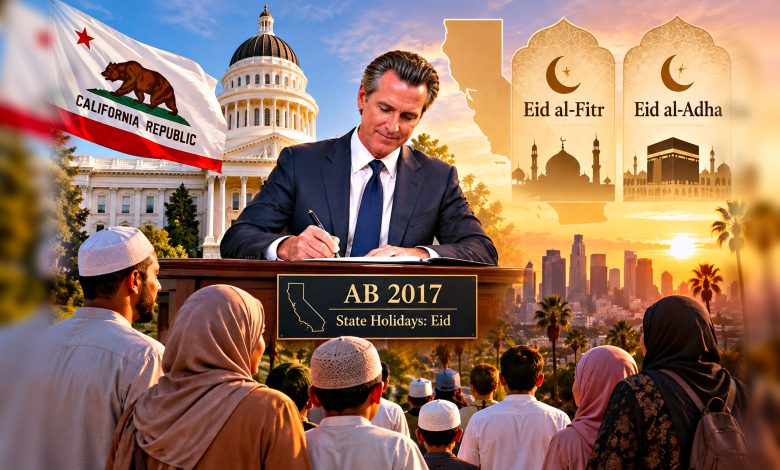
In a landmark development of particular significance to the Muslim community in the United States, California Governor Gavin Newsom has signed Assembly Bill 2017 (AB 2017), officially recognizing Eid al-Fitr and Eid al-Adha as California state holidays a move that further establishes the two major Islamic celebrations within the state’s civic and legal framework.
The California Governor’s Office officially confirmed Newsom’s signing of the legislation in its legislative update issued on September 27, 2026. Among the measures signed by the governor was AB 2017, introduced by San Francisco Assemblymember Matt Haney under the title “State Holidays: Eid.”
The legislation adds Eid al-Fitr and Eid al-Adha to the holidays recognized under California law, a development that Muslim and civil rights organizations have described as significant for Muslims who live, study, and work throughout the state.
What Does the New Law Actually Mean?
Despite the significance of the official recognition, the new law does not mean that all government agencies, schools, courts, and private businesses across California will automatically close for Eid al-Fitr and Eid al-Adha.
This distinction is important in understanding the legislation: recognizing the two Eids as holidays under state law is different from establishing mandatory statewide public holidays requiring all workplaces and educational institutions to close.
The law allows K–12 public schools and community colleges to close for Eid al-Fitr or Eid al-Adha in accordance with applicable local procedures and labor agreements.
Therefore, school closures will not automatically occur statewide. Instead, individual educational authorities may make such decisions based on local policies, arrangements, and employee agreements.
What About State Employees?
AB 2017 also includes provisions that allow state employees and workers at educational institutions to observe the two Eids by using personal leave balances or other available forms of leave, subject to applicable rules and agreements.
The goal is to provide greater flexibility for Muslims who wish to observe their religious holidays without having to choose between their religious commitments and their work or educational responsibilities.
However, the law does not automatically create two paid days off for all employees in California.
Courts Will Not Automatically Close
Another important provision is that the legislation excludes Eid al-Fitr and Eid al-Adha from the definition of judicial holidays.
As a result, recognizing the two Eids as state holidays does not automatically require California courts to close on those days.
The provision reflects an effort by lawmakers to balance official recognition of the religious celebrations with the continued operation of public services and the authority of local institutions to make their own decisions.
Muslim Students and Eid Observance
The legislation also has implications for California’s educational system, particularly regarding student absences associated with religious observances.
State law addresses student absences for religious purposes, helping Muslim students and families observe Eid within the framework of existing educational policies.
This is particularly significant for families when Eid falls on a regular school day or coincides with examinations, classes, or other academic activities.
More Than One Million Muslims in California
CAIR-California, one of the organizations supporting AB 2017, said the legislation addresses a longstanding challenge faced by Muslim students and employees who have sometimes found themselves having to choose between observing their religious holidays and attending school or work.
The organization estimates that more than one million Muslims live in California, making the state home to one of the largest Muslim populations in the United States.
The bill was authored by Assemblymember Matt Haney and received support from several organizations and entities, including CAIR-CA, the Muslim Impact Council, and the California Commission on Asian and Pacific Islander American Affairs.
After passing through the California Legislature, the measure was sent to the governor’s desk, where Newsom officially signed it into law on September 27, 2026.
Washington Took a Similar Step Before California
California is not the first U.S. state to take legislative action recognizing the two Islamic holidays.
On April 8, 2025, Washington Governor Bob Ferguson signed Senate Bill 5106 (SB 5106) concerning the recognition of Eid al-Fitr and Eid al-Adha.
Official Washington state records confirm that the measure was signed on that date and that the legislation recognizes Eid al-Fitr and Eid al-Adha among days formally recognized under state law.
The Washington bill received broad support in the state Senate, passing by a vote of 47–1, before being approved by the House of Representatives by a vote of 68–29.
However, it is important to distinguish between the specific provisions of Washington’s law and California’s legislation. Legislative recognition of Eid does not necessarily mean that either holiday becomes a mandatory closure day or a paid holiday for every employee in a state.
Official Recognition With Broader Social Significance
The signing of AB 2017 carries significance beyond the state calendar. It represents formal recognition of two of the most important religious celebrations in Islam.
Eid al-Fitr marks the end of the holy month of Ramadan, while Eid al-Adha takes place during the annual Hajj pilgrimage season. Both are central religious and community celebrations for Muslims around the world and for Muslim communities throughout the United States.
With Governor Newsom’s signature, Eid al-Fitr and Eid al-Adha now have formal recognition under California state law, while specific rules governing schools, employees, courts, and the continued operation of public services remain in place.
The legislation therefore represents an important development in the recognition of California’s religious and cultural diversity, giving the state’s Muslim community greater formal recognition of its major religious observances within California’s civic framework.
Sources: Office of California Governor Gavin Newsom; California legislative records for AB 2017; CAIR-California; official Washington State records for SB 5106.
https://app.leg.wa.gov/billsummary?billnumber=5106&year=2025&utm_source=chatgpt.com